Never Lost - Just Exploring

Never Lost - Just Exploring
Click for slideshow

Friday, January 18, 2013

New to me motorcycle

As a matter of habit I often surf the internet and especially look at Craigslist for the odd good deal on motorcycles that people want to get oout of their way. One of my hopes, dreams and hobbys is to find and recondition old Japanese motorcycles from the 80's & 90's and after fixing them up, riding them a while , then sell them to finaince my next purchase.

This has ben kinda a "some day" proposition for me for the past few years as money an dtime are always a limiting factor, but this past fall I decided to do something about it and took on a part time job. The job working at a hardware and appliance store pays near minimum wage, but all the wages go directly into my special motorcycle account to help save money for my 'hobby'.

Over the past months I have followed up on a few different UJM (Universal Japanese Motorcycle) that caught my eye.  I even wnet to look at one first hand, and regret that I missed out on a 1984 Goldwing GL1200 Standard in mid summer, however when I found recently on line an advertisement for a Suzuki GS650L in great condition it caught my eye.

I called and spoke to the owner and found he is the second owner of this 1983 motorcycle, He bought it from someone who never rode it and it sat in a garage for years until in 2010 he sold it to his brother. The brother managed to get it running, but not well due to it haveing been in storage and I presume it haas gummed up carbs, but he did ride it a bit and put on some miles over time.

Eventually the brother put the bike back into the rented storage garage wheree I found it, and it sat there for the best part of the past 24 months.

Here is the cool part....759 original miles...!

Yep - all that time the owners who had this bike rarely rode it anywhere...

After some initial bantering on the phone about the price that was listed at $1125 asking price the owner and I decided we were just too far apart with me at about $500 and he at $1000. I said I would sleep on it, and if he reconsidered my offer he should call me. At that point I had no real interest in the bike except to try to buy it right and sell it off ASAP to make some money. But over the weekend I was the one reconsidering and called him back on Monday.


I told him perhaps I should at least come to look at the bike so we made an appointment to meet. We met at the local McDonalds and I followed him to his rented storage facility and was surprised when he opened the door and saw this...

Super clean and complete with all the parts including an extra set of keys and a new side cover for the one with broken tab (battery side). The haggling began in earnest at this point and we finally decided on $800 purchase price, which the experts online saw is a great buy; and the deal was done.


Now this bike sits in my garage, waiting for me to get it running and riding again once spring arrives.







Thursday, December 6, 2012

Riding season - Winter Time

December 6th 2012 and my motorcycle is still in full on operational stand by. That means I have yet to fully winterize it and throw the cover over the top for the 'winter'. I usually do that once the first snows come to my area and the road crews decide to liberally salt the surfaces to prevent icing . The down side to that is the salt is both slippery and highly corrosive to aluminum parts like engines, wheel rims, etc. on my motorcycle. So the first salt usually spells the end of my riding season until the rains of spring come to wash the roads clean once again.

As the winter approaches I am ready for the down time. Just this past weekend I took what I felt was going to be my last ride for the 2012 season. I managed to get in nearly 200 miles just cruising around the countryside near my home.  That wouldn't seem to be a huge deal hwoever for a late late season last ride it was marvelous. These past few weeks I have been carrying fuel stabilzer in the sadddlebag, and whenever I need to refuel I add the appropriate amount just to be sure the bike is ready to go into the short term storage that I practice for the winter months. Thus far I have burned up 3+ tanks full of this mixture; but this recent one looks like it may the last for this year. The weather service is calling for snow over the weekend and that would likely signal storage time for me.

This will not be an issue for me this year. I am really looking forward to taking the bike out of service for a while. I have a short list of service items that I have been avoiding for various reasons as I extended my riding nearly to Christmas. But the time is rapidly approaching when I will take the bike and strip it down to accomplish several tasks that the bike needs done.


One of the main things I need to do is to tear into the bike and remove the meter panel to access the speedo housing. There are several burned out bulbs inside the housing and I struggle reading the speed, tach or other instrumentation at night. While I am in there I also plan on trying to clean and thus fix the clock display that works poorly when the conditions are wet or humid. The clock/channel LCD panel will short out when the moisture accumulates on the circuit board inside the meter panel and then not work, or work so poorly as to be unusable.
 
While I am tearing it apart I plan on removing the radio and sending it to be cleaned, tuned, and bulbs replaced inside it as well. The vendor who does this service for Goldwing radios is also going to add an AUX line in to the radio for me which will eliminate my need to have a cassette adaptor in order to have my iPod or MP3 music inside the system for listening through the helmet headsets.


My current set-up for the GPS also neds some modificatiuon as I changed to a better newer gps this past summer. Here is a picture of how it was set-up for the old unit. The new one requires 4 screws through the back and is larger, heavier and much nicer so I plan on improving this home made engineering GPS bracket. The new one will be taller, lean back at a better angle and be lower and tighter to the panel that supports it . This will keep the GPS from rocking and shaking while riding as it does now (I hope).
 
There are other things I need to do to the bike while it is pieces in my garage, cruise air fliter, sub air filter, fuel filter , and a general clean up will all be on the list, A new front tire in spring and perhaps new bearings on the wheels and steering head bearing replacement  will finalize the to do list for the 2013 riding year.


Wednesday, November 21, 2012

Riding in the darkness

Daylight savings time means commuting home in the dark. In the morning on my way to work I am fortunate enough to come in after the sun has risen and the day is underway. The warming sunlight is welcome and easy to ride in as visibility is excellent.  However during these late fall days in Wisconsin it getes dark around 4:00 PM and I work until 5:00 or later so that means riding in the dark.

My ride home from the office takes me through some dark and dangerous areas as I pass from the more city like suburb where my employment is to the muchmore rural area I live. As I transition from one place to the next the traffic thins, and the street lights fade and the buildings give way to fields, trees and farms. During the summer it is very peaceful to ride away from the noise, hustle and bustle and congestion of the populace and into the calm countryside. In the late Fall  this brings with it a whole new danger especially once the hunting season starts.

The darkness hides the animals waiting in the ditches for their chance to cross the street. Deer especially seem to litter the shoulder during the fall as they become more active looking for a mate, finding food sources as the farmer harvests the fields, and in general keeping ahead of hunters who are seeking to have them as a trophy and sausage.

Of course this forces them to the roadway, and they seem to not be able to discern when it is safe to cross, often walking out into traffic without looking, and suffering the consequences of such dire actions. Dead deer carcass' are commnplace in Wisconsin in the fall from the many car-deer collisions and I worry about becoming a statisitic caught up in this folly known as fall rutting season.


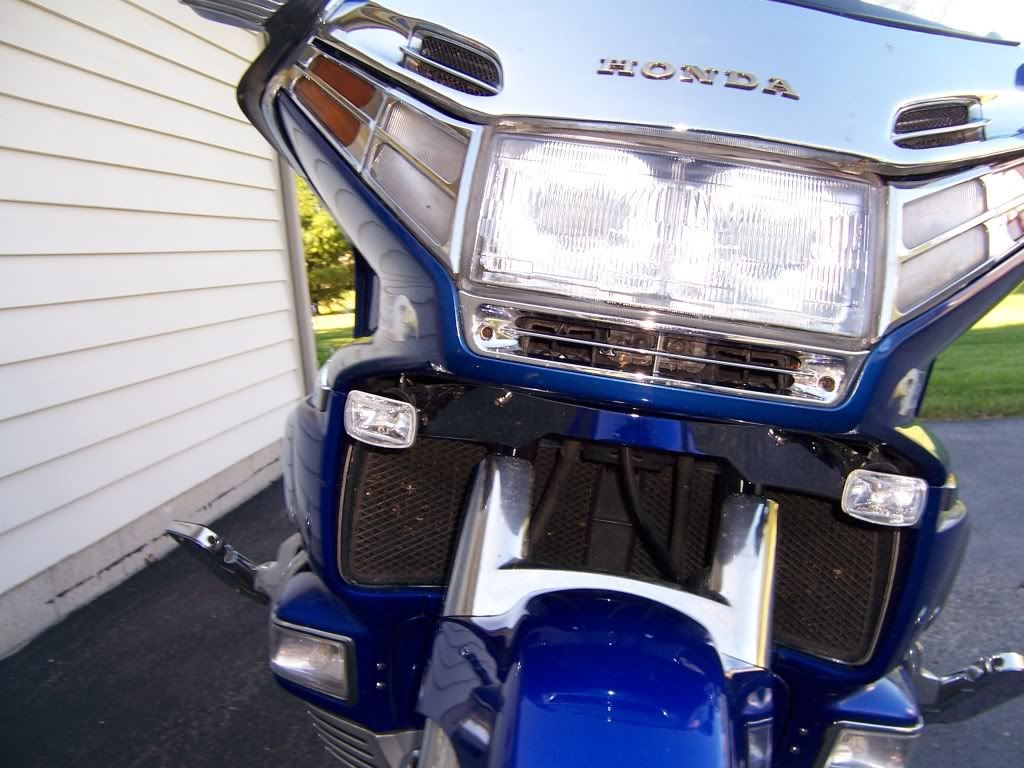
Before adding driving lights
My only defense from a deer suicide is to se them coming. That means lights and more lights shining through the darkness to illuminate the deer well before they get to the road.  Several years ago I had a close encounter with one as I rode home while passing the remnants of a corn field recently harvested by the local dairyman. I spotted the deer standing not 5 feet off the edge of the road as I went past at 55 MPH. The troubling part was that I never saw it until I was nearly on top of it...!


So I decided to add some driving lights. The Goldwing is equiped with some pretty decent headlights to begin with at 45W lows and 55W high beams. I had spent the extra money to upgrade these to 55/65 and the Silverstar high output bright white bulbs. There are 2 bulbs in the headlight assembly so running with my low beams on I had 110 watts of forward facing bright white light at all times. But that wasn't enoogh ...So I added some driving lights I found at Wal*mart. These Optronic Platinum Burners were rated at 55 Watts each and I mounted them to the front on a reshaped chrome trim under the fairing , just below the levelof the headlights.


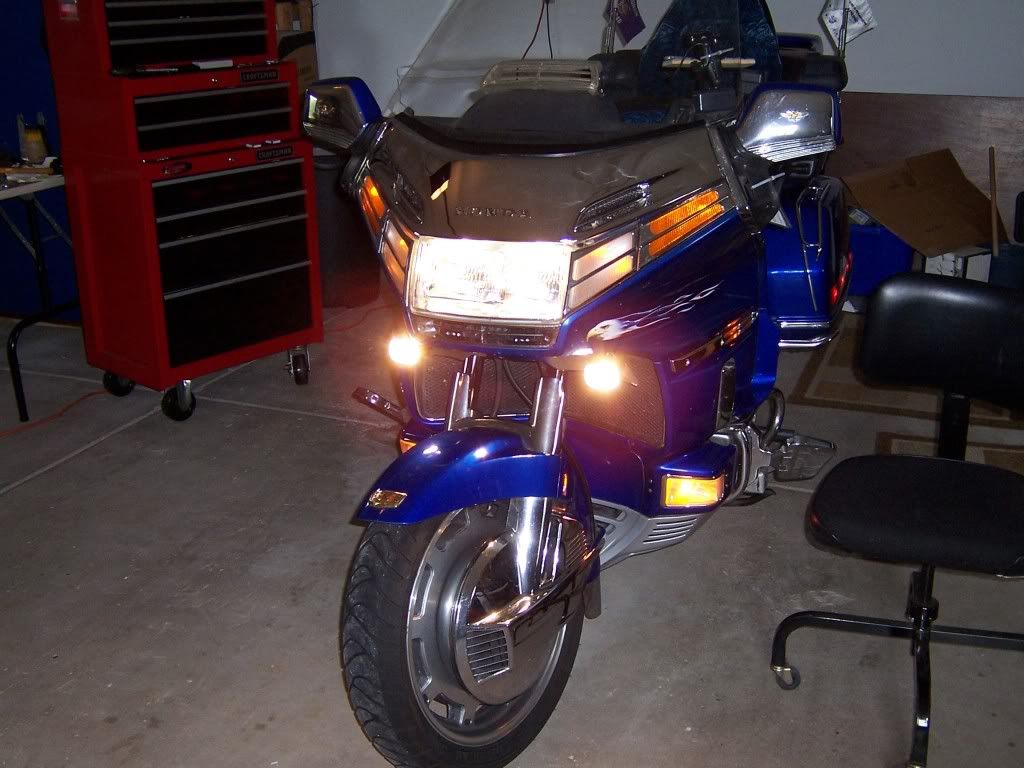
Driving Lights Mounted
NOW I had 220 WATTS of forward facing bright white light wioth just the low beams on. And I further complimented this arrangement by carefully aiming the Right hand side light outward into the ditches and fields to illuminate those pesky critters as they contemplated making a street crossing.

Another advantage is the average car driver; who would not be accustomed seeing a motorcycle out in the late fall typically, will easily see me coming as I am sure I must look like an airplane on final approach with landing lights blazing as I trundle down the roadway.

Wednesday, November 7, 2012

Resistance = Heat

Working on the GL1100 Interstate has immensely expanded my knowledge as I have been forced to learn more by doing. I feel the best lessons are the ones learned first hand, although sometimes I wish it was easier to acquire some of this knowledge.

The probelm presented itself as an intermittent headlight. It would turn off while riding at the oddest moments and then come back on at other times when it was unexpected. I spent hours and hours tracking wiring from the headlight bucket back, Fixing bad connections and poor splices as I went. And I thought I had it fixed - but whe I was test riding it for something else I was working on I noticed the Volt meter was reading higher than normal, and when I investigated I found the headlight was out - again.


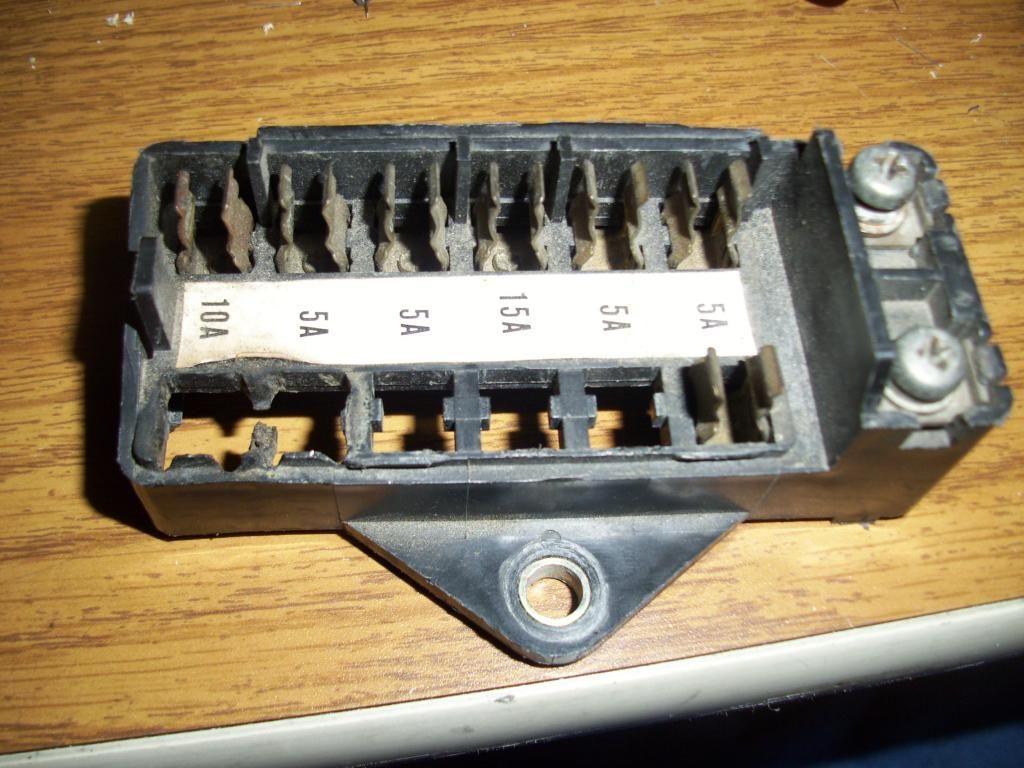
So after some thinking and reading and discussing with fellow riders I figured out the problem must be in the fuse box. When I started to look closer I was shocked to find a badly corroded glass fuse connector on several circuits. And I realized these were the source of the problem. Often the bike would show voltage changing from high to low and this was showing the fuse box actually was allowing electric flow at differing rates as the fuses heated and cooled and the connectors all heated to very dangerous temps.


As I investigated further I soon saw the results of this loose fuse and corrosion as it created extreme excess heat and had started to damage the fuse box itself. This really worried me as I had to resolve this problem before a fire started and someone got injured.  The only thing I could think to do was to replace the entire fuse box - and in the process I wanted to update the fuses to modern blade style automitive fuses so I searched out an alternative box to add to the 1980 Goldwing.  The challenge was to find a box that allowed for ganging the first 4 lines together (a procees known asa "bus") as seen on this photo - see the bar along the bottom ?
 
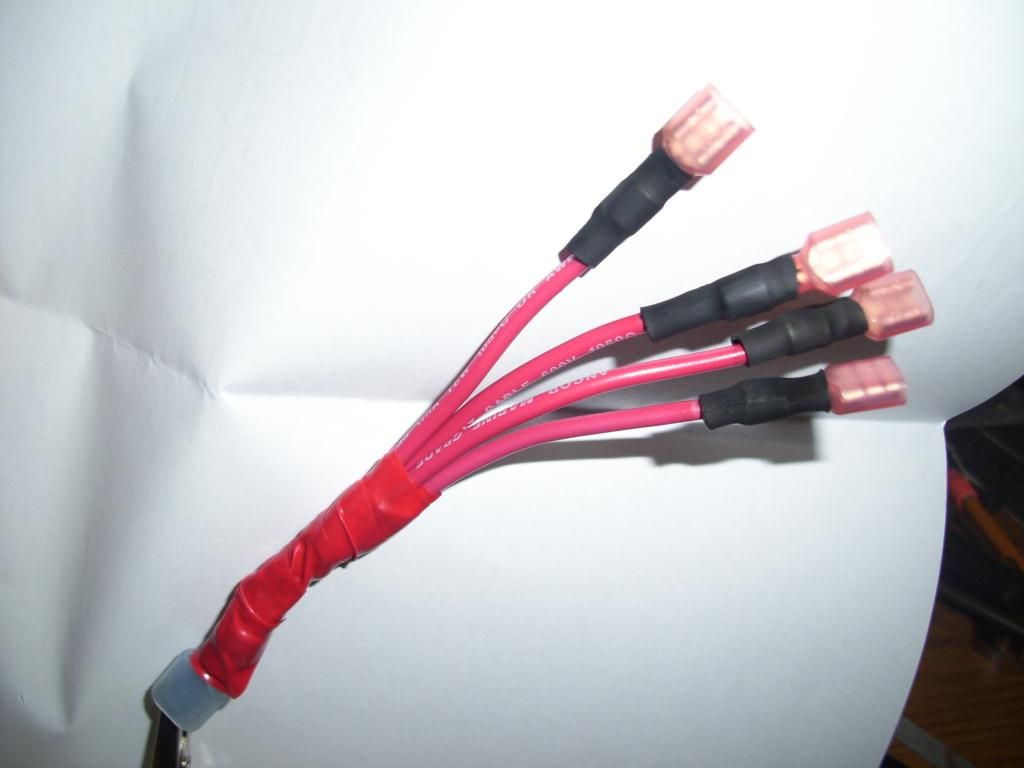
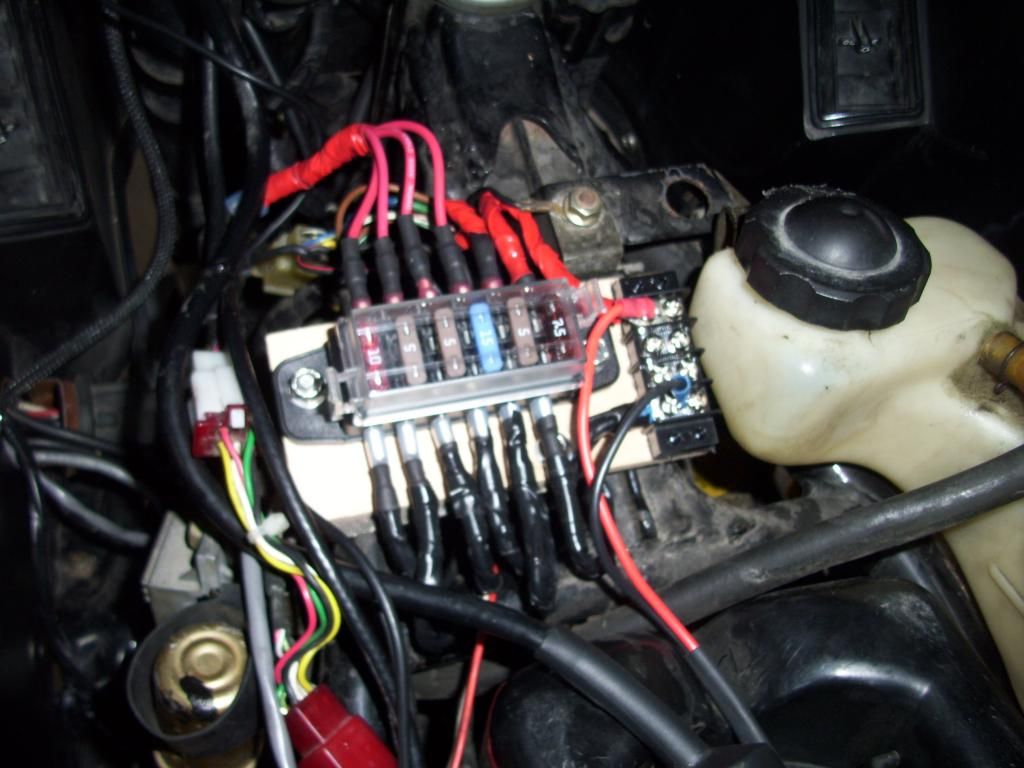
This proved to be more of an effort than I first thoought - finding an inline 6 place fuse box with a bus or jumpers was almost impossible - in fact so difficult that I decided to create my own ganging line and use a 6 place inline box I found on Amazon. This required me to make a 4 line connector that leads from the 1 main power wire to 4 seperate fuses - so my meager soldering skills were put to the test. I elected to solder and heat shrink everything I could as I built the new fuse box in order to keep it as safe as possible for the future.
 
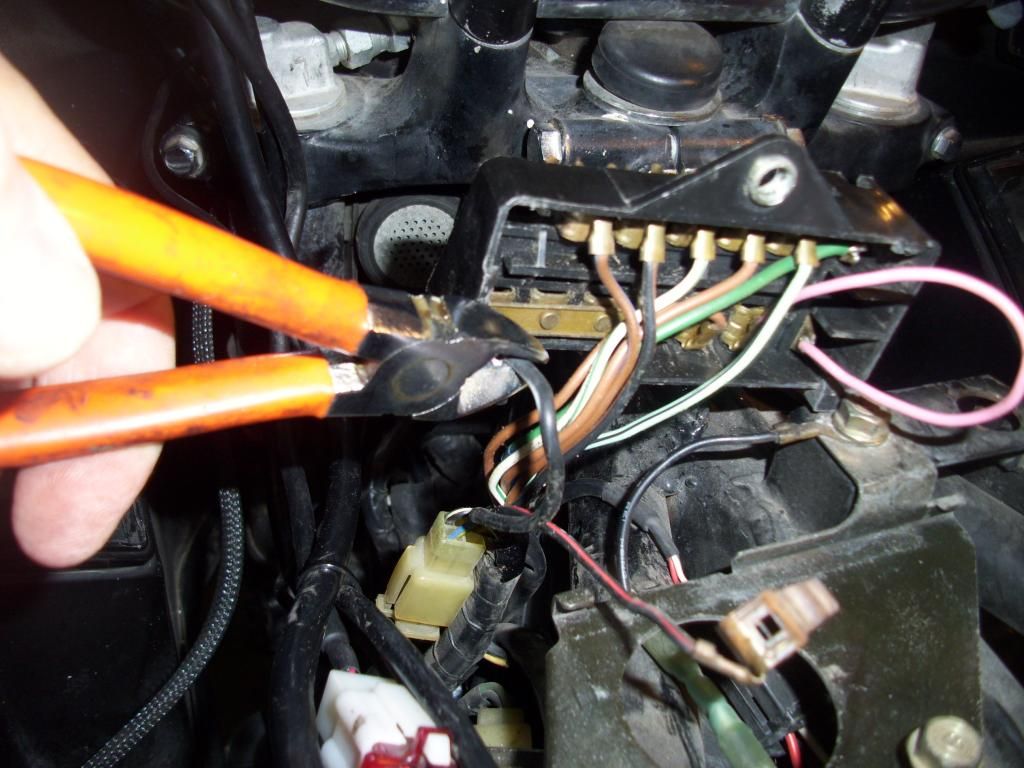
I simple then cut one wire at a time and created a new line into the fuse box with crimped connectors and shrink tubing all covered in a protective wrap of electrical tape appropriately colored for hot (red) or ground (black).  These crimp connections are not ideal (soldered is better) but I have alot of confidence in my crimps as I have experience with them on my old 1200 and on my current 1500 and I have learned how to do them so they will last.  Here you can see me preparing to make one of the first cuts as I worked my way across the fuse block.
 

Eventually I was able to get all the wires reconnected to the new block and even added some extra accesory slots on the far right for adding low amperage electrics like GPS and radios and auxillary lighting witrh LEDs. Once this was done I took the bike out for a test ride and noticed almost immediately the power was better, the lights were brighter and I knew I had made an awesome upgrade on this old but new-to-us bike.


Tuesday, October 16, 2012

In the magazine ! Not exactly what I planned...


In early spring I usually take my motorcycle out of "winter storage" and start getting it ready for a new season of riding. This takes place in late February or early March...whenever the weather starts to break and I can stand the temps in the garage long enough to get something done...

In 2012 the weather was pretty good early and I had a lot to do on 2 bikes (mine and my sons) so I got them out and started to work toward our riding season. As luck would have it we had a sizable snow fall followed by a few really nice days, and the conditions outside where pristine and enticing. Seeing an opportunity I moved my bike outside to take advantage of the high contrast between the crisp white snow that had fallen overnight and the Sparkling Pearl Blue of my motorcycle.

I carefully snapped a series of pictures and took great care to format several with a lot of open space at the top of the picture. I knew that the Goldwing Road Riders Assn magazine "Wing World" preferred this type of picture so they could position their header along the top without covering the photo itself. This is what I was hoping for..a cover shot!

After I submitted the picture I herd nothing from the Editor nor staff at the magazine, and was not sure they even had received it, but I placed my confidence  in the e-mail system and patiently waited. I felt that if they were going to use my shot it would be during the winter as it was a snow shot, and that I just had to be patient and wait it out...

Then one day I got an e-mail from a buddy who told me to turn to page 52 of the just released October issue of the magazine.... The editor had decided to use it a cover page for an article written by one of the Goldwing experts they have on staff instead of a cover shot....

Nice try anyway....


Thursday, September 27, 2012

Financial realities - Old motorcycle love is expensive

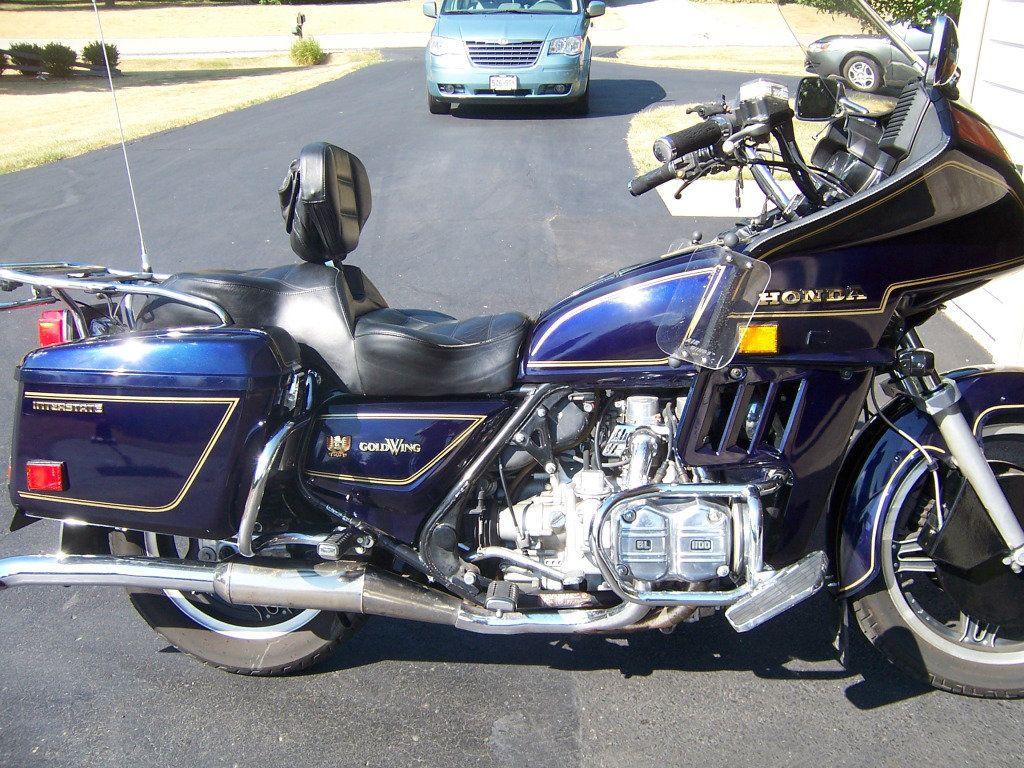
It has been quite some time since I last posted and I have learned several lessons about loving and restoring (rejuvenating?) oldish motorcycles.  The old 1982 CX500 Custom that spent some time in my garage and being ridden by my 18 years old son is now gone and an even older GL1100 Interstate Goldwing from 1980 has taken it's place.

It seems the CX500 was outgrown rapidly ( at about 6000 total miles ridden) and that was somewhat expected anyway. It was that reason that found my son cruising the internet on Craigslist and tripping over an ad for a 1980 Goldwing. It seems the owner was using it to commute daily into the city from his home in the crowded suburbs and was tiring of dodging traffic with a large touring bike. He was seeking to sell the Goldwing, and find a smaller more nimble bike that would deliver excellent fuel economy as well as reliability and maneuverability. The CX fits that bill remarkably as the courier services knew in the lat 70's and early 80's as this was eventually the primary use of this bike.

After several exploratory e-mails were traded, my son asked me to go look at this bike he was thinking about trading his CX for...(he owned the CX even though is was registered to both of us in order to reduce insurance costs). I asked to read his e-mail exchange and found that not only did this deal look legit, it was a guy I knew from the Goldwing club going back several years.

So we went to look at this bike -

After the test ride, the negotiations led us to conclude that after stripping off some of the extras hanging on the CX, we could make the trade even up --so that is how this bike came to live in my garage.

Trade made, and registration complete, we started into the task of making this bike as up to date and reliable as possible. During this phase of riding and testing we soon discovered that the overall maintenance on the bike had fallen woefully behind.


Simple things like brake fluid levels, coolant, and brake pads were neglected. The clutch cable need replacing, and adjustment, and the valve tappets had not been adjusted for some time. The tires needed replacing , but we knew that going in,  but the other more simple things are the ones that I worried about. It is more about the lack of caring, and not so much about the expense of caring that I worry about. If these bikes are neglected and just ridden hard and put away, they tend to break down rather sooner than later.

So - I was relegated to doing ALL the maintenance that had been forgotten or ignored for some time in an effort to at least create a time line base for our regular intervals going forward.

Here is where the costs come in and a dose of reality appears. I am convinced the previous owner was not so concerned about the riding the  bike , as much as the cost  of maintaining the bike going forward . He had reached a precipice of potential debt as one looks at all the things that needed doing.  And if his financial situation was not liquid, it would be back breaking.  Here are the things we have decided to do and the approximate costs so far... bear in mind I have not factored in any LABOR hours as I do all this work myself...

Clutch Cable - $20
Oil change - $20
Radiator flush & fill - $20
Rear final drive flush & fill - $10
New brake pads (3 sets) & Master cylinder rebuild kits (2 sets Front & rear) & caliper rebuild kits (3 sets) - $250
Tires (pending spring) - $175
Final Drive Moly - $10
Brake fluid flush & fills - $10
Clutch cable adjustments - $0 but several hours
New battery - $100 (in spring)

Add - ons -
LED lights - TBD
Handlebar CB Radio - $0.00 - we already owned it at about $300

So in total a little over $600 to get it road worthy and dependable again...

That is the hidden cost of an older motorcycle. These costs are static across any bike one may own however these maintenance items come up at differing intervals if you already own the bike and the costs are not so apparent. And if one is tight on cash as many are recently due to the economic downturn suffered these past few years these items can be shuffled into the future. But they can not be ignored forever, and I think that is the hurdle the previous owner faced, and did not want to deal with, when he traded off his much more valuable bike for a cheaper model.

Considering the actual investment coast of both bikes at this point it seems we have the better end of the deal... The CX represents a total investment of about $1200 so that becomes the base cost of the GL. Add on the $600 and we are into the GL for under $1900 and the real worth of it in the spring sellers market would be $2200 approximately. The added benefit is that my son gets to ride a bigger, better smoother bike when we travel together next summer, and probably increase his ability to go farther in any one day without testing the limits of his endurance.


Ergonmic comparison CX500 Custom vs GL1100 Interstate

Friday, August 3, 2012

Just a little something to think about

I found this on an internet forum in someones signature line. I thought it was cool and to the point so I copied it here for future consumption...

You see things vacationing on a motorcycle in a way that is completely different from any other. In a car you’re always in a compartment, and because you’re used to it you don’t realize that through that car window everything you see is just more TV. You’re a passive observer and it is all moving by you boringly in a frame.

On a cycle the frame is gone. You’re completely in contact with it all. You’re in the scene, not just watching it anymore, and the sense of presence is overwhelming. That concrete whizzing by five inches below your foot is the real thing, the same stuff you walk on, it’s right there, so blurred you can’t focus on it, yet you can put your foot down and touch it anytime, and the whole thing, the whole experience, is never removed from immediate consciousness.


--Robert Pirsig, "Zen and the Art of Motorcycle Maintenance"